Marcus Furius Camillus: The Life of Rome's Second Founder

Marcus Furius Camillus: The Life of Rome's Second Founder
"#ad" Get the book (USA) at https://amzn.to/3YTpOkj
"#ad" Get this book (UK) at https://amzn.to/3DYQwi9
Camillus served as a censor, was elected to six consular tribuneships, appointed dictator five times, and enjoyed four triumphs. He toppled mighty Veii, ejected the Senones from Rome following its sacking, and helped orchestrate a grand compromise between the patricians and plebeians. The Romans even considered him Rome's second founder - a proud appellation for any Roman - and revered him for being an exemplar of Roman virtue. Interestingly, he never held the consulship. Plutarch stated that Camillus had avoided it on purpose, and for good reason. The office was often at the heart of controversy, given that patricians dominated it for most of Camillus' life. The appointment of a dictator was an emergency measure taken only in the direst of situations and the fact that Camillus was repeatedly appointed speaks of a period when the young Republic was surrounded by enemies and still fighting for survival. Without Camillus' efforts the city may never have fulfilled its great destiny. Marc Hyden sifts the fragmentary and contradictory sources and, while acknowledging that much legend and exaggeration quickly accrued around Camillus' name, presents the story of this remarkable life as the ancient Romans knew it.
 
Follow Roman History on X @romanhistory1 or https://x.com/romanhistory1 
 

Justinian: Emperor, Soldier, Saint

Justinian: Emperor, Soldier, Saint
"#ad" Get this book USA at https://amzn.to/3EO0Aee
"#ad" Get the book UK at https://amzn.to/3Lvj2vO
A definitive new biography of the Byzantine emperor Justinian
 
Justinian is a radical reassessment of an emperor and his times. In the sixth century CE, the emperor Justinian presided over nearly four decades of remarkable change, in an era of geopolitical threats, climate change, and plague. From the eastern Roman—or Byzantine—capital of Constantinople, Justinian’s armies reconquered lost territory in Africa, Italy, and Spain. But these military exploits, historian Peter Sarris shows, were just one part of a larger program of imperial renewal. From his dramatic overhaul of Roman law, to his lavish building projects, to his fierce persecution of dissenters from Orthodox Christianity, Justinian’s vigorous statecraft—and his energetic efforts at self-glorification—not only set the course of Byzantium but also laid the foundations for the world of the Middle Ages.
 
Follow Roman History on X @romanhistory1 or https://x.com/romanhistory1 

Rome and Persia: The Seven Hundred Year Rivalry

Rome and Persia: The Seven Hundred Year Rivalry

"#ad" Get this book UK at https://amzn.to/3QpK1w6
"#ad" Get the book USA at https://amzn.to/3qMyBIa
 
 The epic rivalry between the ancient world's two great superpowers

The Roman empire was like no other. Stretching from the north of Britain to the Sahara, and from the Atlantic coast to the Euphrates, it imposed peace and prosperity on an unprecedented scale.

Its only true rival lay in the east, where the Parthian and then Persian empires ruled over great cities and the trade routes to mysterious lands beyond. This was the region Alexander the Great had swept through, creating a dream of glory and conquest that tantalized Greeks and Romans alike. Tracing seven centuries of conflict between Rome and Persia, historian Adrian Goldsworthy shows how these two great powers evolved together. Despite their endless clashes, trade between the empires enriched them both, and a mutual respect prevented both Rome and Persia from permanently destroying the other.

Epic in scope, Rome and Persia completely reshapes our understanding of one of the greatest rivalries of world history.

Roman History on Twitter at https://twitter.com/romanhistory1

Author biography: Robert Bruton

Author biography: Robert Bruton
New author whose first book on the life of Roman General Flavius Belisarius is scheduled to come out later this summer
 
I am an American author and a former CIA operations officer who was primarily assigned to Africa and the former Soviet Union. I have a BA in history from the University of St. Thomas and a MA in world history from Norwich University, where I completed my thesis on the role of climate change in the decline of the Roman Empire. I live near Washington, D.C. with my wife and children.
Author Robert Bruton
www.authorrobertbruton.com
 
I became interested in Roman history during my undergraduate studies and pursued graduate studies to further my knowledge. When I was thinking about what to write my thesis on, I decided I wanted to add some new insight into the decline of the Roman Empire. An increase in evidence from the "natural archives" (ice cores, tree rings, sedimentology, palynology, entomology, etc.) made me realize that we in the twenty-first century have access to a wide range of new scientific evidence about paleo-climate change that was not available to previous students of Roman history. Evidence pointed to a series of massive volcanic eruptions in the year 536 AD that led to a climate catastrophe such as had never been seen in human history. The decade that followed 536 was the coldest in the past six thousand years. Trees stopped growing; summer frosts killed crops; food shortages and famine followed. And then in 542, the Empire got hit with a double-whammy: the cold temperatures created the ideal climate for the Yersinia pestis bacteria that causes bubonic plague, and within a year, perhaps half the population of the empire was gone. I thought it was a story worth telling, and General Flavius Belisarius, one of the most brilliant and resourceful generals in history, seemed to be the best one to do it.
 
 
"#ad" Get the book USA at https://amzn.to/4mdSNtg
"#ad" Get this book UK at https://amzn.to/4piVHQd

Pax: War and Peace in Rome's Golden Age

Pax: War and Peace in Rome's Golden Age
"#ad" Get this book UK at https://amzn.to/3Nzs7UC
"#ad" Get the book USA at https://amzn.to/3qG1Ooa
 
The definitive history of Rome's golden age - antiquity's ultimate superpower at the pinnacle of its greatness
 
The Pax Romana has long been revered as a golden age. At its peak, the Roman Empire stretched from Scotland to Arabia, and contained perhaps a quarter of humanity. It was the wealthiest and most formidable state the world had yet seen.
 
Beginning in 69AD, a year that saw four Caesars in succession rule the empire, and ending some seven decades later with the death of Hadrian, Pax presents a dazzling history of Rome at the height of its power. From the gilded capital to realms beyond the frontier, historian Tom Holland portrays the Roman Empire in all its predatory glory. Vivid scene follows vivid scene: the destruction of Jerusalem and Pompeii, the building of the Colosseum and Hadrian's Wall, the conquests of Trajan. Vividly sketching the lives of Romans both ordinary and spectacular, from slaves to emperors, Holland demonstrates how Roman peace was the fruit of unprecedented military violence.
 
A stunning portrait of Rome's glory days, this is the epic history of the pax Romana.
 
Follow Roman History on X @romanhistory1 or https://x.com/romanhistory1
 

Walking the Antonine Wall


Walking the Antonine Wall:
A Journey Across Scotland from East to West
 
"#ad" Get this book at https://amzn.to/3Jbmxad
Walking the Antonine Wall charts a voyage on foot along one of Scotland's most fascinating ancient monuments - a 38 mile rampart constructed in the second century AD by the Romans to mark what would briefly become the northernmost frontier of their vast empire. It is a personal account of Dr Alan Montgomery's encounters with the enigmatic remains of this Roman frontier which have inspired myths and legends and intrigued and baffled generations of chroniclers, antiquarians and archaeologists. Leading through wild open spaces and along city streets, past curiosities man-made and natural, ancient and modern, it records a journey across central Scotland and through 2000 years of Scottish history.
  
Follow Roman History on X @romanhistory1 or https://x.com/romanhistory1

Raven Kamali Writes Roman Historical Fiction

Raven Kamali Writes Roman Historical Fiction
and Launches Her New Book
 
I was born in Iran into a family of historians and poets, so I grew up loving both disciplines. When I migrated to Australia, the first history book I bought was Thucydides’s History of The Peloponnesian War from the Penguin Classics series. I enjoyed it so much that I read it multiple times. The next book was Polybius’s. Now I had to read every book on the Punic Wars and my favorite hero, Scipio Africanus the Elder. Several books later, I enrolled at the University of Queensland to study ancient history and the classical languages of Latin and Greek. It was one of the most incredible experiences of my life as the veil to the past lifted, and I stepped into the ancient world.
Raven Kamali - Author of 'The Dark Side of Glory'
After my gradunation, it was time for me to make a career choice: become an ancient historian or a novelist. As a busy mum, I couldn’t do both, so I chose the latter. And I had a dream. I wanted to write a historical novel that was relevant to our times. The inspiration for the story was primarily based on my personal experience and reading Josephus. The Battle of the Teutoburg recorded by Tacitus, Cassius Dio, and Velleius Paterculus added the necessary dimension I needed to advance the plot.
"#ad" Get the book USA at https://amzn.to/4gyby94
Thus, I began my journey and wrote The Dark Side of Glory. A powerful novel of love and friendship, deceit and treachery, hatred and vengeance, and political intrigue that tells the story of a young Jewish woman facing unimaginable horrors for refusing to bow to religious fanaticism.

Read Raven Kamali's Reflections on “The Dark Side of Glory” at
http://romanancienthistory.blogspot.com/2020/12/reflections-on-dark-side-of-glory.html

Follow Roman History on X @romanhistory1 or https://x.com/romanhistory1
"#ad" Get this book UK at https://amzn.to/39Dd75w
"#ad" Get the book USA at https://amzn.to/4gyby94
 

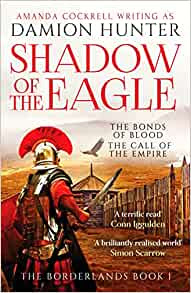
Shadow of the Eagle

Shadow of the Eagle: An epic adventure of Ancient Rome
"#ad" Get the Kindle at https://amzn.to/3JO0WRP
"#ad" Get this book at https://amzn.to/3vh4Ptv
 
Will Britain take him in... or mark him as its enemy?
 
Faustus Valerianus is the son of a Roman father and a British mother, a captive sold among the spoils after Claudius's invasion.
 
Now both parents have died within a month of each other, and so he sells the family farm and enlists, joining legendary general Agricola's campaign to conquer the entirety of the British Isles culminating in a devastating battle amongst Caledonia's dark mountains.
 
But Faustus will have to contend with more than ferocious British warriors and whip-cracking elements. For the bonds of blood can weigh heavy on one's soul. The call of his mother's true people. His father's restless shadow. Faustus must carry them with him...
 
Follow Roman History on X @romanhistory1 or https://x.com/romanhistory1
 

Journey to Britannia: From the Heart of Rome to Hadrian's Wall, AD 130

New Book - Order Now
Journey to Britannia:
From the Heart of Rome to Hadrian's Wall, AD 130

"#ad" Get the Kindle at https://amzn.to/3K0jgrs
"#ad" Get this book at https://amzn.to/3M9IXYO

'An erudite and fascinating work' Jan Morris, New York Times

'An artful combination of history, archaeology and the imagination' Mary Beard, New York Review of Books

'Riley manages to bring multi-faceted, polygot and multi-cultural Roman Britain to vibrant life for specialists and generalists' Country Life

It is AD 130. Rome is the dazzling heart of a vast empire and Hadrian its most complex and compelling ruler. Faraway Britannia is one of the Romans' most troublesome provinces: here the sun is seldom seen and 'the atmosphere in the country is always gloomy'.

What awaits the traveller to Britannia? How will you get there? What do you need to pack? What language will you speak? How does London compare to Rome? Are there any tourist attractions? And what dangers lurk behind Hadrian’s new Wall?

Combining an extensive range of Greek and Latin sources with a sound understanding of archaeology, Bronwen Riley describes an epic journey from Rome to Hadrian's Wall at Britannia's – and the empire's – northwestern frontier. In this strikingly original snapshot of Roman Britain, she brings vividly to life the smells, sounds, colours and textures of travel in the second century AD.

Follow Roman History on X @romanhistory1 or https://x.com/romanhistory1

Bar Kokhba: The Jew Who Defied Hadrian and Challenged the Might of Rome

Bar Kokhba: The Jew Who Defied Hadrian
and Challenged the Might of Rome
 
"#ad" Get the book USA at https://amzn.to/3Q5rx3r
"#ad" Get this book UK at https://amzn.to/3fum9nx
 
BAR KOKHBA is the search for the truth of the epic struggle between two strong-willed leaders over who would rule a nation. One was Hadrian, the cosmopolitan ruler of the vast Roman Empire, then at its zenith, who some regarded as divine; the other was Shim'on, a Jewish military leader in a district of a minor province, who some believed to be the ‘King Messiah'. It is also the tale of the clash of two ancient cultures. One was the conqueror, seeking to maintain control of its hard-won dominion; the other was the conquered, seeking to break free and establish a new nation: Israel. During the ensuing conflict - the ‘Second Jewish War' - the highly motivated Jewish militia sorely tested the highly trained professional Roman army. The rebels withstood the Roman onslaught for three-and-a-half years (AD 132 - 136). They established an independent nation with its own administration, headed by Shim'on as its president. The outcome of that David and Goliath contest was of great consequence, both for the people of Judaea and for Judaism itself. So, who was this insurgent Shim'on known today as ‘Bar Kokhba'? How did Hadrian, the Roman emperor who built the famous Wall in northern Britain, respond to the challenger? And how, in later ages, did this rebel with a cause become a hero for the Jews in the Diaspora longing for the foundation of a new Israel in modern times? This book describes the author's personal journey across three continents to establish the facts. _BAR KOKHBA_ is lucidly written by the author of the mould-breaking Augustus at War and the acclaimed biographies Germanicus and Marcus Agrippa. Drawing on archaeology, art, coins, inscriptions, militaria, as well as secular and religious documents, Lindsay Powell presents a fascinating account of the people and events at a crucial time in world history
 
Follow Roman History on X @romanhistory1 or https://x.com/romanhistory1