Marcus Tullius Cicero

Marcus Tullius Cicero
 
Marcus Tullius Cicero was born on the 3rd of January 106 BC at Arpinum in central Italy into a wealthy family of the equestrian order. He was educated in Rome where he studied law and also studied rhetoricians and philosophers in Greece. Cicero became a scholar, lawyer and statesman in the Roman republic, later becoming a consul and the Governor of Cilicia (southern (Mediterranean) coast of Turkey). He is known as one of Rome's greatest orators. Cicero joined the army briefly before embarking on his law career. He would take on risky cases and would win them and this made him quite famous!

Lawless Republic
The Rise of Cicero and the Decline of Rome
 
"#ad" Get the book USA at https://amzn.to/40bdRHT
"#ad" Get this book UK at https://amzn.to/4aezcVG
The collapse of law and order in the last years of the Roman Republic told through the rise and fall of its most famous lawyer, Cicero. In its final decades, the Roman Republic was engulfed by crime. Cases of extortion, murder and insurrection gave an ambitious young lawyer named Cicero high-profile opportunities to litigate and forge a reputation as a master debater with a bright political future. In Lawless Republic, leading Roman historian Josiah Osgood recounts the legendary orator's ascent and fall, and his pivotal role in the republic's lurch toward autocracy. Cicero's first appearance in the courts came shortly after the end of a brutal civil war. After leveraging his fame as a lawyer to become a consul, he ruthlessly crushed a coup by suppressing the liberties of Roman citizens. The premiere legal mind of Rome came to argue that the pursuit of a higher justice could sometimes justify sweeping the law aside, laying the groundwork for Roman history's most famous act of political violence - the assassination of Julius Caesar. Lawless Republic vividly resurrects the spectacle of the courts in the time of Cicero and Caesar, showing how politics trumped the rule of law and sealed the fate of Rome.
 
 Cicero believed strongly in the Roman Republic and when he was made consul in 63BC he tried to stop the Republic being overthrown. He accused Lucius Sergius Catilina (Catiline) of leading a plot to overthrow the Roman Senate. The Catiline or Catilinarian Orations are a set of speeches given to the Roman Senate. The senate bestowed the tittle Pater Patriae, meaning "Father of the Country" onto Cicero.
Cicero Denounces Catiline, fresco by Cesare Maccari, 1882–88
Picture Wikipedia
Caesar was an ambitious politician and was part of a powerful alliance known as the First Triumvirate which included Pompey and Marcus Licinius Crassus. Caesar had asked Cicero to join this but Cicero refused making himself an enemy of Caesar. Cicero was frightened of Caesar's ambition for power. Caesar had Cicero exiled from Rome in 56BC but he returned a year later.

During the civil war of Caesar and Pompey, Cicero fled Rome again. Caesar had taken control of the city and had become dictator of Rome. Cicero was pardoned by Caesar and he was allowed back to Rome. In 44BC when Caesar was assassinated, Cicero was not disappointed and he lead the Senate to try and re-establish the Roman Republic.

Cicero Selected Works

"#ad" Get the book USA at https://amzn.to/40rmuiL
"#ad"Get this book UK at https://amzn.to/3diClGb
Lawyer, philosopher, statesman and defender of Rome's Republic, Cicero was a master of eloquence, and his pure literary and oratorical style and strict sense of morality have been a powerful influence on European literature and thought for over two thousand years in matters of politics, philosophy, and faith. This selection demonstrates the diversity of his writings, and includes letters to friends and statesmen on Roman life and politics; the vitriolic Second Philippic Against Antony; and his two most famous philosophical treatises, On Duties and On Old Age - a celebration of his own declining years. Written at a time of brutal political and social change, Cicero's lucid ethical writings formed the foundation of the Western liberal tradition in political and moral thought that continues to this day.

Cicero was a staunch opponent of Mark Antony. Antony was one of the leading men wanting to fill the power vacuum after Caesar's death. Antony, Octavian and Lepidus, formed the second Triumvirate and took control of Rome and they sought out their enemies. They declared Cicero a public enemy and killed him in 43BC and his final words were "there is nothing proper about what you are doing, soldier, but do try to kill me properly." Cicero's head and hands were cut off and nailed to the Rostra of the Forum Romanum.

The writings of Cicero would have influenced many writers for generations to come and Historians would have learned a lot about the Roman government at this time even if his politics were not always popular. He wrote many works relating to philosophy, such as On the Republic, On Invention, and On the Orator. His son Marcus became a consul in 30 BC.
 
Follow Roman History on X @romanhistory1 or https://x.com/romanhistory1
  
Cicero: Politics and Persuasion in Ancient Rome
"#ad" Get the book USA at https://amzn.to/3R03inO
"#ad" Get this Book UK at https://amzn.to/3b7rKin
As the greatest Roman orator of his time, Cicero delivered over one hundred speeches in the law courts, in the senate and before the people of Rome. He was also a philosopher, a patriot and a private man. While his published speeches preserve scandalous accounts of the murder, corruption and violence that plagued Rome in the first century BC, his surviving letters give an exceptional glimpse into Cicero's own personality and his reactions to events as they unravelled around him events, he thought, which threatened to destabilize the system of government he loved and establish a tyranny over Rome. From his rise to power as a self-made man, Cicero's career took him through the years of Sulla, and the civil war between Pompey and Caesar, to his own last fight against Mark Antony. Drawing chiefly on Cicero s speeches and letters, as well as the most recent scholarship, Kathryn Tempest presents a new, highly readable narrative of Cicero's life and times from his rise to prominence until his brutal death. Including helpful features such as detailed chronological tables, a glossary, a guide to Greek and Roman authors and maps, the volume balances background and contextual information with analysis and explanation of Cicero's works. Organized chronologically and according to some of his most famous speeches, Cicero will appeal to anyone with an interest in Roman history, oratory and politics in the ancient world. This accessible yet comprehensive guide provides a thorough introduction to this key ancient figure, his works and influence, and the troubled political times in which he operated.
 

The Roman Poet 'Virgil'

The Roman Poet 'Virgil'
 
Publius Vergilius Maro better known to us as Virgil was born on the 15th of October 70 BC at Andes in Northern Italy. He later died at Brundisium in Southern Italy on the 21st of September 19 AD. Virgil was born to a lower class family, raised on a farm and was educated at Cremona (Milan) and then finished at Rome. He learnt the art of rhetoric and studied philosophy. His education included Greek and Roman authors, especially the poets. Siro the Epicurean philosopher also taught Virgil at his school in Naples. Virgil mentions Siro in the poem “Appendix Vergiliana” Virgil never married and lived almost like a recluse concentrating on his poems.
Mosaic of Virgil
Image wikipedia.org
This Mosaic of Virgil can be found on the site of the ancient Hadrumetum and currently preserved in Bardo National Museum in Tunis, where it constitutes one of its key pieces. It is currently the oldest portrait of the Latin poet Virgil
 
Virgil witnessed the end of the Roman Republic, lived through the civil wars of Marius and Sulla, Pompey and Julius Caesar, When Virgil was at the age of 20, Caesar crossed the River Rubicon and initiated several civil wars. Caesar was assassinated on the Ides of March 44BC (15th of March) and his nephew Octavian (later Augustus) ended these civil wars at the battle of Actium in 31BC.
 
Virgil is perhaps known as the greatest Roman poet famed for his work “The Aeneid” an epic poem in 12 books. This was styled on Homer's Iliad and Odyssey. It follows the Trojan refugee Aeneas as he struggles to fulfill his destiny and reach Italy, where his descendants Romulus and Remus were to found the city of Rome. It also includes the civil wars and the reign of Augustus including the tragedy of Dido, the queen of Carthage who killed herself by her affection for Aeneas, It is the story of the earliest days of Rome, a national epic honoring Rome and prophesying the rise of the Roman Empire.

The Aeneid
"#ad" Get the book USA at https://amzn.to/3ZZ5tuo
"#ad" Get this book UK at https://amzn.to/2Gdx8TK
After a century of civil strife in Rome and Italy, Virgil wrote the Aeneid to honour the emperor Augustus by praising his legendary ancestor Aeneas. As a patriotic epic imitating Homer, the Aeneid also set out to provide Rome with a literature equal to that of Greece. It tells of Aeneas, survivor of the sack of Troy, and of his seven-year journey: to Carthage, where he falls tragically in love with Queen Dido; then to the underworld,; and finally to Italy, where he founds Rome. It is a story of defeat and exile, of love and war, hailed by Tennyson as 'the stateliest measure ever moulded by the lips of man'
 
 Ovid, another Roman poet knew Virgil and Ovid would of been influenced by Virgil's work. Ovid would of been much younger then Virgil and eventually Ovid's writing would get him banished from Rome by Emperor Augustus!

Virgil died of fever in 19BC and on his deathbed asked that the 'Aeneid' be burnt as he had not finished the final edits but Emperor Augustus requested that it be published. Virgil will always be best known for three major works of Latin literature, the Eclogues (or Bucolics), the Georgics, and the epic Aeneid.
The Eclogues and Georgics
"#ad" Get the book USA at https://amzn.to/41NfxZM
"#ad" Get this book UK at https://amzn.to/32aUFgr
The Eclogues, ten short pastoral poems, were composed between approximately 42 and 39 BC, during the time of the 'Second' Triumvirate of Lepidus, Anthony, and Octavian. In them Virgil subtly blended an idealized Arcadia with contemporary history. To his Greek model - the Idylls of Theocritus - he added a strong element of Italian realism: places and people, real or disguised, and contemporary events are introduced. The Eclogues display all Virgil's art and charm and are among his most delightful achievements. 
 
Between approximately 39 and 29 BC, years of civil strife between Antony, and Octavian, Virgil was engaged upon the Georgics. Part agricultural manual, full of observations of animals and nature, they deal with the farmer's life and give it powerful allegorical meaning. These four books contain some of Virgil's finest descriptive writing and are generally held to be his greatest and most entertaining work, and C. Day Lewis's lyrical translations are classics in their own right.

Follow Roman History on X @romanhistory1 or https://x.com/romanhistory1
 

The Little Known Roman Emperor Called “Saloninus”

The Little Known Roman Emperor Called “Saloninus”

Publius Licinius Cornelius Saloninus Valerianus is better known to us as “Saloninus”. He was born in the year 242AD to Gallienus and Salonina and was their second son. His elder brother Valerian II was proclaimed Caesar in 256AD and fought alongside his father Gallienus at the Danubian front. Valerian II died early in 258AD captured and killed by Shapur I of the Sassanid Empire. His father, Emperor Gallienus then demoted the commander Ingenuus who had been hailed the new emperor by the legions of Moesia (Central Serbia) in favour of Valerian's son. Gallienus met Ingenuus on the battlefield at Mursa (modern Croatia) where Gallienus's General, Aurelian, led the troops to victory over Ingenuus. Ingenuus survived the battle but to avoid capture drowned himself in a nearby river.
Blue Glass Bust of Saloninus in the Roman-Germanic Museum in Cologne
Photo: cointalk.com
 
Saloninus was made Caesar in Gaul in 258AD and was put under the protection of the praetorian prefect Silvanus.

The silver coinage of Saloninus undergoes a severe debasement in 259AD. Before the year ends, the antoninianus becomes debased to the point where the silver content is less than 40%.
This Antoninianus was minted at Lugdunum (Lyon, France) in 256 AD and shows Saloninus as Ceasar. The obverse shows a radiate and draped bust and the legend "SALON VALERIANVS CAES". The reverse shows Spes walking left, holding a flower and raising the hem of the dress with the legend "SPES PVBLICA" meaning "the hope of the public".

Spes was the Roman personification of Hope, normally depicted carrying flowers. On this coin, the Caesar, Saloninus, the designated successor of the emperor, is identified as the hope for the future of the Roman people.


In 260AD Silvanus ordered Postumus to give over the booty that he had won in a successful raid on a German warband who had raided Gaul. Postumus's men refused and turned on Saloninus and Silvanus, who had to flee to Cologne with some loyal troops. Postumus was then acclaimed emperor by his army. Postumus surrounded Saloninus and Silvanus in Cologne.

Gallienus was engaged in the Danube and could not save his son, Saloninus. So in desperation proclaimed Saloninus emperor hoping that this would induce Postumus's army to desert him and join them in a bid for Empire. The citizens of Colonia Agrippina handed Saloninus and Saloninus over to their enemy. The army of Postumus murdered them. Soloninus's reign as sole Emperor only lasted a few weeks or months of his accession in the year of 260AD.

The Reign of Emperor Gallienus: The Apogee of Roman Cavalry
"#ad" Get this book USA at https://amzn.to/4m40N0l
"#ad" Get the book UK at https://amzn.to/35v95Zp
This is the only fully illustrated military life of the Emperor Publius Licinius Egnatius Gallienus (253-268). Considered the most blatantly military man of all of the soldier emperors of the third century, Gallienus is the emperor in Harry Sidebottom's bestselling Warrior of Rome novels. Gallienus faced more simultaneous usurpations and foreign invasions than any other emperor, but somehow he managed to survive. Dr. Ilkka Syvanne explains how this was possible. It was largely thanks to the untiring efforts of Gallienus that the Roman Empire survived for another 1,200 years. Gallienus was a notorious libertarian, womanizer, and cross-dresser, but he was also a fearless warrior, duellist and general all at the same time. This monograph explains why he was loved by the soldiers,yet so intensely hated by some officers that they killed him in a conspiracy. The year 2018 is the 1,800th anniversary of Gallienus' date of birth and the 1,750th anniversary of his date of death. The Reign of Gallienus celebrates the life and times of this great man.
 
Gallienus after losing two sons, made no effort to elevate his third son, Egnatius Marinianus, although he did allow him to be elected to the ceremonial office of Consul in 268AD. Gallienus died in September 268AD.

Romans at War:
The Roman Military in the Republic and Empire
By Dr. Simon Elliott
"#ad" Get this book USA at https://amzn.to/3ITI0Gz
"#ad" Get the book UK at https://amzn.to/30yEFnl
In Romans at War ground-breaking research is presented in an accessible, entertaining, and sumptuously illustrated format, including: • A new consideration of the nature of late Roman military leaders; the author argues they were effectively independent warlords

Follow Roman History on X @romanhistory1 or https://x.com/romanhistory1

The Roman Historian - Livy

The Roman Historian - Livy

Titus Livius best known to us as Livy was a Roman historian. He was born in either 64 or 59 BC at the prosperous city of Patavium (now Padua) which was located in the province of Cisalpine Gaul but later was absorbed into Italy. Whilst Livy was still young, Julius Caesar was Governor and gave Roman citizenship to its inhabitants.

The Early History of Rome
"#ad" Get the book USA at https://amzn.to/4n20sw7
"#ad" Get this book UK at https://amzn.to/365OZXE
'I hope my passion for Rome's past has not impaired my judgement; for I do honestly believe that no country has ever been greater or purer than ours or richer in good citizens and noble deeds'
Livy dedicated most of his life to writing some 142 volumes of history, the first five of which comprise The Early History of Rome. With stylistic brilliance, he chronicles nearly 400 years from the founding of Rome to the Gallic invasion in 386 BC, an era that witnessed the establishment of the Republic, unrest and brutal conflict. Bringing compelling characters to life, and re-presenting familiar tales - including the tragedy of Coriolanus and the story of Romulus and Remus - The Early History is a truly epic work, and a passionate warning that a nation should learn from its history.

Its possible that the boy Livy may of heard stories about the wars in Gaul. Livy studied rhetoric and philosophy growing up and there is no accounts on his early career. Livy never got accustomed to military matters and his writings show this but it did not stop him becoming a distinguished historian. At the age of 10, Caesar and Pompey the Great were having a civil war and the outcome would be decided in 48BC at the battle of Pharsalus.

After the assassination of Caesar a new round of civil wars followed. In 44/43BC, Livy may of observed some of this fighting. Octavian, Caesar's adopted son was victorious after the battle of Actium in 31BC and he would bring peace and stability to Italy.
 
Rome's Mediterranean Empire
"#ad" Get this book USA at https://amzn.to/4pjNoDG
"#ad" Get this book UK at https://amzn.to/331RcS9
These words from one of Rome's opponents encapsulate the authority Rome achieved by its subjugation of the Mediterranean. The Third Macedonian War, recounted in this volume, ended the kingdom created by Philip II and Alexander the Great and was a crucial step in Rome's eventual dominance. For Livy, the story is also a fascinating moral study of the vices and virtues that hampered and promoted Rome's efforts in the conflict. He presents the war not so much as a battle against Perseus, Alexander's last and unworthy successor, than as a struggle within the Roman national character. Only traditional moral strength, embodied in Lucius Aemilius Paullus, the general who ultimately defeats Perseus, ensures the Roman victory.

Livy moved to Rome around 29BC or earlier as he started writing the History of Rome, so one would assume he had moved there before he started writing this. Augustus took an interest in Livy and he also helped educate the future emperor Claudius. Livy never mentions the poets Horace, Virgil, and Ovid of the literary world of Rome so one assumes he was not closely (if at all) involved with them. Livy published the first five books of his History of Rome from its foundation between 27 and 25BC whilst in his early thirties. This most famous work narrates a complete history of the city of Rome, from its foundation to the death of Augustus. It has embellished accounts of Roman heroism and emphasizes the great triumphs of Rome. All this to flatter the Emperor Augustus and his new style of government.

We know very little of Livy's private life but he was married and he had two children, a son and a daughter who was married to a teacher of oratory named Lucius Magius. Livy did not belong to the inner circle of Augustus, Rome's first emperor, but he and the emperor respected each other. Livy encourage the young prince Claudius to write history and this included his histories of Rome, Carthage and the Etruscans.
 
Livy The War with Hannibal
"#ad" Get the book USA at https://amzn.to/3IlpPK5
"#ad" Get this book UK at https://amzn.to/3j1M85A
In The War with Hannibal, Livy (59 BC-AD 17) chronicles the events of the Second Punic War between Rome and Carthage, until the Battle of Zama in 202 BC. He vividly recreates the immense armies of Hannibal, complete with elephants, crossing the Alps; the panic as they approached the gates of Rome; and the decimation of the Roman army at the Battle of Lake Trasimene. Yet it is also the clash of personalities that fascinates Livy, from great debates in the Senate to the historic meeting between Scipio and Hannibal before the decisive battle. Livy never hesitates to introduce both intense drama and moral lessons into his work, and here he brings a turbulent episode in history powerfully to life.

Livy became a well known person, but lacked the popularity of Ovid, Horace and Virgil. Livy died in 17AD in his home city of Patavium.
 
The History of Rome
"#ad" Get the book USA at https://amzn.to/4pisrcp
"#ad" Get this book UK at https://amzn.to/3mL8yKJ
In addition to Valerie Warrior's crisp, fluent translation of the first five books of Livy's Ab Urbe Condita, this edition features a general introduction to Livy and his work, extensive foot-of-the-page notes offering essential contextual information, and a chronology of events. Three appendices--on the genealogies of the most prominent political figures in the early Republic, Livy's relationship with Augustus, and Livy's treatment of religion--offer additional insight into the author and the early history of Rome.
 
Follow Roman History on X @romanhistory1 or https://x.com/romanhistory1

How to Survive in Ancient Rome

  ***New Book***
How to Survive in Ancient Rome
 

"#ad" Get the book USA at https://amzn.to/4a8ChXb

"#ad" Get this book UK at https://amzn.to/2Gx6y8Q
Imagine you were transported back in time to Ancient Rome and you had to start a new life there. How would you fit in? Where would you live? What would you eat? Where would you go to have your hair done? Who would you go to if you got ill, or if you were mugged in the street? All these questions, and many more, will be answered in this new how-to guide for time travellers. Part self-help guide, part survival guide, this lively and engaging book will help the reader deal with the many problems and new experiences that they will face, and also help them to thrive in this strange new environment.
 
Follow Roman History on X @romanhistory1 or https://x.com/romanhistory1
 

Publius Cornelius Tacitus - Roman Historian

Publius Cornelius Tacitus
One Of The Greatest Roman Historians
 
Tacitus was a Roman historian, politician and orator who was born in the year 56AD in northern Italy (Cisalpine Gaul) or, more probably, in southern Gaul (Gallia Narbonensis (south-eastern France)). He was possibly born into an aristocratic family but there is no proof of this. He had a good education where he studied rhetoric, the art of speaking in public and law which prepared him for an administrative post. In the year 77, he married the daughter of the Govenor of Britain Gnaeus Julius Agricola, who was one Rome's most distinguished generals for his successful British campaigns. He studied whilst in the final years of Emperor Nero and the Year of the Four Emperors and also lived during the reigns of Vespasian, Titus, Domitian, Nerva and Trajan.
 
Agricola and Germania
 
"#ad" Get the book USA at https://amzn.to/3PQxsIR
"#ad" Get this book UK at https://amzn.to/3iWfO4j
The Agricola is both a portrait of Julius Agricola - the most famous governor of Roman Britain and Tacitus' well-loved and respected father-in-law - and the first detailed account of Britain that has come down to us. It offers fascinating descriptions of the geography, climate and peoples of the country, and a succinct account of the early stages of the Roman occupation, nearly fatally undermined by Boudicca's revolt in AD 61 but consolidated by campaigns that took Agricola as far as Anglesey and northern Scotland. The warlike German tribes are the focus of Tacitus' attention in the Germania, which, like the Agricola, often compares the behaviour of 'barbarian' peoples favourably with the decadence and corruption of Imperial Rome.

In 81 or 82 Tacitus became Quaestor which is a Roman magistrate which gave him entry to the Senate. Between 89 to 93 he was promoted to praetor which included the command of a legion or governorship of a province. Tacitus was a good friend of Pliny the Younger.

In AD68 Nero's suicide marked the end of the first dynasty of imperial Rome. The following year was one of drama and danger, though not of chaos.
 
The Histories
"#ad" Get the book USA at https://amzn.to/3K4IHxr
"#ad" Get this book at https://amzn.to/32UGKeR
In the surviving books of his Histories the barrister-historian Tacitus, writing some thirty years after the events he describes, gives us a detailed account based on excellent authorities. In the 'long but single year' of revolution four emperors emerge in succession: Galba, Otho, Vitellius and Vespasian - who established the Flavian dynasty.

Tacitus was lucky enough to live in the Silver Age of Latin literature and is thought to be one of the greatest Roman historians. He is famous for his works especially for the Histories and Annals covering the Julio-Claudians upto Domitian and his other surviving works include Agricola, Germania and Dialogue on Oratory. He died around 120AD at the age of 64.

Annals
 
 "#ad" Get this book USA at https://amzn.to/4mWVEI6
"#ad" Get this book UK at https://amzn.to/3cnycAk
A compelling new translation of Tacitus' Annals, one of the greatest accounts of ancient Rome, by Cynthia Damon. 
 
Tacitus' Annals recounts the major historical events from the years shortly before the death of Augustus to the death of Nero in AD 68. With clarity and vivid intensity Tacitus describes the reign of terror under the corrupt Tiberius, the great fire of Rome during the time of Nero and the wars, poisonings, scandals, conspiracies and murders that were part of imperial life. Despite his claim that the Annals were written objectively, Tacitus' account is sharply critical of the emperors' excesses and fearful for the future of imperial Rome, while also filled with a longing for its past glories.

Follow Roman History on X @romanhistory1 or https://x.com/romanhistory1

Verica - The British Client King of the Romans

Verica - The British Client King of the Romans.
 
Verica became king around 15AD after his elder brother Eppillus. He was the king of the Atrebates. Rome recognised him as "REX or KING' and they had a good relationship with each other with diplomatic and trade links.
 
In the summer of 42AD Caratacus and Togodumnus, the sons of Cunobelinus, king of the Catuvellauni, (who recently died), wanted to expand their territory into Verica's Kingdom which covered south-central Britain (modern Sussex, Berkshire, and Hampshire).
 
After the invasion, Verica ran to Rome for help. Verica, as a 'client king' of Rome asked Emperor Claudius to reclaim his throne. A year later, Claudius used this as a pretext for the Roman invasion of Britain.
 
The future emperor Vespasian would fight the British Celts in the south near Exeter. Claudius's successful invasion of Britain brought her under control of the Roman Empire.
 
The Romans restored Verica or at least his heir Tiberius Claudius Cogidubnus as client-king of the Romans in the Atrebates's territory. He was a local tribal leader and a Latin speaker who had lived and been educated in Rome.

Celtic Silver Unit of Verica (10-40AD) 
 This coin was issued before the Roman conquest when emperor Tiberius was still emperor.
 
This obverse shows a nude male figure holding a lituus, a wand or augur's staff in the right hand, wearing a headpiece with a chin strap, and gazing skyward holding an object held in his left hand. It has been suggested (by Chris Rudd) that he is holding a Druid's or serpent's Egg.
 
The legend COMMI F meaning son of Commius. In 51 BC Commius was an ally of Caesar and then switched sides to help Vercingetorix at the siege of Alesia. Commius being on the losing side tried to make an offer with Caesar’s lieutenant Marc Antony. This being unsuccessful he fled to Britain.
 
The roman style augur on this silver coin may allude to druidic fortune telling. The intended message may be that the future looks good with the son of Commius.
 
The reverse shows the laureate head of Tiberius and the legend Verica. Tiberius was the emperor of Rome (from 14 to 37 AD) during the period that Verica was the king of the Atrabetes (10 - 43 AD). It is obviously a political statement saying, both, "I honour Tiberius and Rome" and "Liken me to Tiberius". This coin was minted between 25 to 35 AD.
 
Photo: British Museum
A gold aureus of Claudius, showing an arch inscribed with "Victory over the Britons" (Devictis Britannis). It shows a triumphal arch in Rome honouring emperor Claudius's successful invasion of Britain in 43AD. These type of coins were minted circa 46-47AD and the arch was dedicated later in 51AD.

Related Books
Heirs of King Verica: Culture & Politics in Roman Britain
 
"#ad" Get the book USA at https://amzn.to/4giNk2Z
"#ad" Get this book UK at https://amzn.to/3245QYB
Britain is traditionally considered to have been conquered by the Romans in AD43. In fact the intervention took place because an important faction of the Atrebates tribe under King Verica persuaded the Emperor Claudius to intervene against other Britons who had invaded its territory. Central southern Britain was liberated by a forced landing in Chichester harbour and thereafter remained largely free from the influence of the Roman army. It became Roman under the patronage of a powerful high king, Tiberius Claudius Togidubnus. Cultural and artistic life flourished, melding Celtic and Roman features into a brilliant new civilization which reached its apogee in the fourth century, when the former protectorate became Britannia Prima with its capital at Cirencester. After the early fifth century, the cessation of coinage made the financing of public buildings, villas and associated works of art impossible, but something survived of Roman Britain in the distinctive British Latin, the insular version of Christianity and the style of minor works of art. In a real sense Britannia Prima was the predecessor of Alfred's Wessex. This revolutionary interpretation of British life in the first millennium AD, beginning with Verica's flight and ending with Alfred and Bishop Asser, is presented as the Roman Britons (well versed in Ovid & other Roman writers) would doubtless have seen it.
 
Claudius: A Life From Beginning to End
"#ad" Get the book USA at https://amzn.to/3Swjz3t
"#ad" Get this book at https://amzn.to/3583Dx9
Often portrayed as an awkward, disfigured, and clumsy man, Claudius was the unlikely ruler of the Roman Empire from 41 CE to 54 CE. His reign would prove to be one of the longest of the time even though his rise to the throne did not come without opposition. Virtually no-one in Claudius’ family wanted to see him become emperor—only when he turned out to be the last surviving man of the Julio-Claudian dynasty did he ascend to the throne.
 
one ever expected that the boy that was used as the comparative standard for stupidity by his own mother would become the emperor of Rome. Yet, he did. Claudius reign was riddled with conspiracies and attempts on his life by the Senate that was supposed to serve him. But despite all the opposition to his rule, Claudius would go on to be an able and efficient leader. He expanded the Roman Empire more than any other emperor had since the reign of Augustus.

Follow Roman History on X @romanhistory1 or https://x.com/romanhistory1

Mark Feeley - Writes A Roman Adventure Novel

Roman History Blog - Featured Author

Mark Feeley - Writes A Roman Adventure Novel
  
Thirty or more years ago, I bought a copy of Ammianus Marcellinus’ History of the Later Roman Empire.” After reading it, I was hooked. The characters, the politics, the drama were all totally absorbing and created a rip-roaring tale which ended in the Roman defeat at Adrianople. I began to wonder, who were these people? How did they feel about the world around them and an empire which was beginning to crumble and fade? To find out more I completed an MA in Classical Civilisation at the University of London. I then toyed with the idea of doing something academic but baulked at the thought of having to learn Latin (I admire those who can). Instead I decided to write a book, thinking that this would give me the freedom to write about all the Roman things I love.
  
Author Mark Feeley
Reading Ammianus Marcellinus led to this book being written!
  
The Realm of a God is the final product. It is the start of an adventure story which will traverse the era. Servius, an ambitious Burgundian prince, must build a career for himself at an imperial court which is riven by conspiracy and faction. Valentinian, the aging emperor, is in poor health and those around him are beginning to search for a successor. Against this backdrop, Servius must journey to Rome to seize two champion racehorses. It is a task which will bring him into contact with the subtle scheming of the powerful Anicii, and the barbarous cruelty of the bagaudae.
 
The Realm of a God
 

"#ad" Get the book USA at https://amzn.to/3WguII3

"#ad" Get this book UK at https://amzn.to/2Qf1l6z
Rome is crumbling. Beyond the Alps, the barbarian tribes are gathering. As part of a peace agreement, Servius, a young Burgundian prince, arrives as a hostage at the emperor’s court. Set to work in the imperial stables Servius soon makes new friends, but as he waits to become a soldier the world around him is changing. The emperor is ill and the succession in doubt. As others plot, Servius departs for Rome to seize two champion racehorses. Faced by the jealousy of the Anicii and the blood curdling brutality of the bagaudae, he can only survive by protecting the emperor’s honour ….
 
Ammianus Marcellinus - The Later Roman Empire: (AD 354-378)
This book inspired our Featured Author Mark Feeley! 
 
"#ad" Get this book USA at https://amzn.to/3DYHzs1
"#ad" Get this book UK at https://amzn.to/2Ys39h7
Ammianus Marcellinus was the last great Roman historian, and his writings rank alongside those of Livy and Tacitus. The Later Roman Empire chronicles a period of twenty-five years during Marcellinus' own lifetime, covering the reigns of Constantius, Julian, Jovian, Valentinian I, and Valens, and providing eyewitness accounts of significant military events including the Battle of Strasbourg and the Goth's Revolt. Portraying a time of rapid and dramatic change, Marcellinus describes an Empire exhausted by excessive taxation, corruption, the financial ruin of the middle classes and the progressive decline in the morale of the army. In this magisterial depiction of the closing decades of the Roman Empire, we can see the seeds of events that were to lead to the fall of the city, just twenty years after Marcellinus' death.
   
Follow Roman History on X at https://x.com/romanhistory1
 

Roman Butcher and his Bookkeeping Wife

Famous Funerary Relief of a Roman Butcher
and his Bookkeeping Wife
  
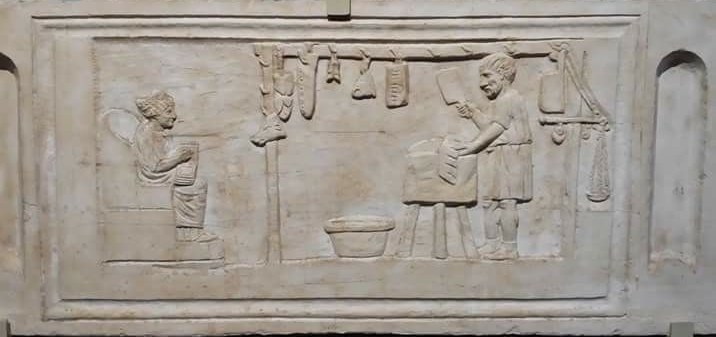
Ancient Roman butchers had standardized chopping blocks, hatchets and cleavers along with refined butchery practices. This second Century funerary relief panel shows a typical Roman butchers shop. The butcher is by his table with his hatchet
and the meat displayed on the walls. His bookkeeping
wife sits opposite.
 
An ancient Roman relief with a scene of a butcher shop.
Rome, 120-150 AD
 
Relief Museo della Civiltà Romana. Rome, Lazio, Italy. Photo: pinterest.com

Recently in Ipplepen, Devon, England, a Roman butchers shop has been discovered. Cow bones found at the site prove that this butcher slaughtered local cows for their prime cuts of meat. This prime beef along with other meats was delivered by road using the sophisticated road system of the empire in the 4th century AD.

  
A cow skull being unearthed at the Ipplepen site.
(Ipplepen Archaeology Project)
Photo: smithsonianmag.com
 
The normal practice for cattle would have been to keep them into old age for the pulling of ploughs etc. but at this site, they were one and a half to two years old. The right age for producing the highest quality meat. This means that this site was being used for professional beef production.

Ancient Roman Cooking: Ingredients, Recipes, Sources
"#ad" Get this book UK at https://amzn.to/2UVqKEJ
"#ad" Get the book USA at https://amzn.to/3DyntoE

This lively, authoritative account of a crucial period in Britains history has been revised and updated to incorporate the very latest findings and research. Guy de la Bédoyère the popular face of Romano-British archaeological studies puts the Roman conquest and occupation within the larger context of Romano-British society and how it functioned. With nearly 300 illustrations and dramatic aerial views of Roman sites, and brimming with the very latest research and discoveries, Roman Britain will delight and inform all those with an interest in this seminal epoch of British history.
 
Follow Roman History on X @romanhistory1 or https://x.com/romanhistory1
 

Rob Edmunds - Writes Roman Historical Novels

Roman History Blog - Featured Author

Rob Edmunds - Writes Novels of Roman Historical Interest

Firstly, I would like to thank David from Roman ancient history for giving me the opportunity to introduce my books to everyone. Unusually, the two books I've written on Roman themes will be published together. Perhaps that’s a good thing as, if you enjoy the first one, you won’t have to wait to see how the story unfolds! The first is entitled Masinissa: Ally of Carthage and its sequel is Masinissa: Ally of Rome. Both take a distinctive perspective on some of the major events that occurred during the Second Punic War. There have been novels which feature Rome and Carthage as the main actors in that conflict, but I’ve taken the third major force in the region for my novels. Numidia was divided into two kingdoms at the time, the Massylii which supported Carthage and the Masaesyli which was allied with Rome. The hero of my books was a Numidian prince who would ultimately unify Numidia and turn it into the breadbasket of Rome. He would rule a unified Numidia for 54 years. He is still revered today across eight countries in North Africa and the Sahel region as the founding father of the Amazigh / Berber people. The story begins in 213BC at the point when Masinissa is entering the war as the commander of a powerful cavalry force and concludes a little after the climactic Battle of Zama in 202BC.
Masinissa: Ally of Carthage (Book 1)

 
"#ad" Get the book USA at https://amzn.to/4jchcyW
 "#ad" Get this book UK at https://amzn.to/30U7taL

My interest in this story was a little accidental. I’ve always had a strong interest in the classical period and Mediterranean civilization, but I’d never heard about Masinissa before, which I suspect may be a common admission from even those people who are very knowledgeable about Roman history. My interest grew as I researched the period and events and came across people who knew far more about them than I did. One conversation was particularly striking. I was speaking with a professor of ancient history from a quite eminent university and he told me that he felt the decision Masinissa took to abandon his alliance with Carthage and instead forge an alliance with Rome was one of the five most momentous decisions ever taken in history. There may be some bias in that contention, but it brought home to me just how important Masinissa’s story was. He weakened Carthage and strengthened Rome. If Carthage had won that war, so many things in our world might be different, right down to the most fundamental things like the alphabet and language I’m using now. Another thing which galvanised and motivated me was the very positive and encouraging comments and interactions I’ve received from people within the Amazigh community in North Africa and elsewhere. He is a very important historical and cultural figure across the entire region.
Follow Roman History on X @romanhistory1 or https://x.com/romanhistory1