Mark Feeley - Writes A Roman Adventure Novel

Roman History Blog - Featured Author

Mark Feeley - Writes A Roman Adventure Novel
  
Thirty or more years ago, I bought a copy of Ammianus Marcellinus’ History of the Later Roman Empire.” After reading it, I was hooked. The characters, the politics, the drama were all totally absorbing and created a rip-roaring tale which ended in the Roman defeat at Adrianople. I began to wonder, who were these people? How did they feel about the world around them and an empire which was beginning to crumble and fade? To find out more I completed an MA in Classical Civilisation at the University of London. I then toyed with the idea of doing something academic but baulked at the thought of having to learn Latin (I admire those who can). Instead I decided to write a book, thinking that this would give me the freedom to write about all the Roman things I love.
  
Author Mark Feeley
Reading Ammianus Marcellinus led to this book being written!
  
The Realm of a God is the final product. It is the start of an adventure story which will traverse the era. Servius, an ambitious Burgundian prince, must build a career for himself at an imperial court which is riven by conspiracy and faction. Valentinian, the aging emperor, is in poor health and those around him are beginning to search for a successor. Against this backdrop, Servius must journey to Rome to seize two champion racehorses. It is a task which will bring him into contact with the subtle scheming of the powerful Anicii, and the barbarous cruelty of the bagaudae.
 
The Realm of a God
 

"#ad" Get the book USA at https://amzn.to/3WguII3

"#ad" Get this book UK at https://amzn.to/2Qf1l6z
Rome is crumbling. Beyond the Alps, the barbarian tribes are gathering. As part of a peace agreement, Servius, a young Burgundian prince, arrives as a hostage at the emperor’s court. Set to work in the imperial stables Servius soon makes new friends, but as he waits to become a soldier the world around him is changing. The emperor is ill and the succession in doubt. As others plot, Servius departs for Rome to seize two champion racehorses. Faced by the jealousy of the Anicii and the blood curdling brutality of the bagaudae, he can only survive by protecting the emperor’s honour ….
 
Ammianus Marcellinus - The Later Roman Empire: (AD 354-378)
This book inspired our Featured Author Mark Feeley! 
 
"#ad" Get this book USA at https://amzn.to/3DYHzs1
"#ad" Get this book UK at https://amzn.to/2Ys39h7
Ammianus Marcellinus was the last great Roman historian, and his writings rank alongside those of Livy and Tacitus. The Later Roman Empire chronicles a period of twenty-five years during Marcellinus' own lifetime, covering the reigns of Constantius, Julian, Jovian, Valentinian I, and Valens, and providing eyewitness accounts of significant military events including the Battle of Strasbourg and the Goth's Revolt. Portraying a time of rapid and dramatic change, Marcellinus describes an Empire exhausted by excessive taxation, corruption, the financial ruin of the middle classes and the progressive decline in the morale of the army. In this magisterial depiction of the closing decades of the Roman Empire, we can see the seeds of events that were to lead to the fall of the city, just twenty years after Marcellinus' death.
   
Follow Roman History on X at https://x.com/romanhistory1
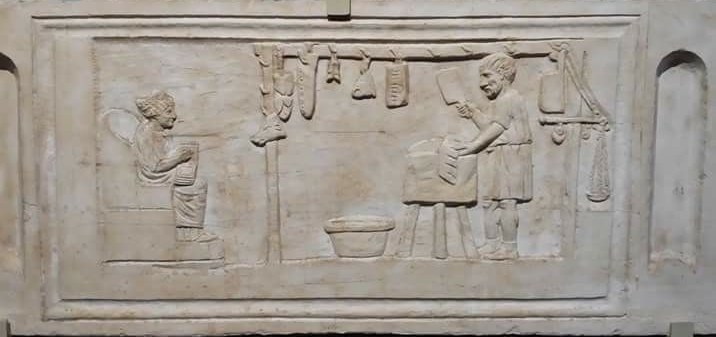
 

Roman Butcher and his Bookkeeping Wife

Famous Funerary Relief of a Roman Butcher
and his Bookkeeping Wife
  
Ancient Roman butchers had standardized chopping blocks, hatchets and cleavers along with refined butchery practices. This second Century funerary relief panel shows a typical Roman butchers shop. The butcher is by his table with his hatchet
and the meat displayed on the walls. His bookkeeping
wife sits opposite.
 
An ancient Roman relief with a scene of a butcher shop.
Rome, 120-150 AD
 
Relief Museo della Civiltà Romana. Rome, Lazio, Italy. Photo: pinterest.com

Recently in Ipplepen, Devon, England, a Roman butchers shop has been discovered. Cow bones found at the site prove that this butcher slaughtered local cows for their prime cuts of meat. This prime beef along with other meats was delivered by road using the sophisticated road system of the empire in the 4th century AD.

  
A cow skull being unearthed at the Ipplepen site.
(Ipplepen Archaeology Project)
Photo: smithsonianmag.com
 
The normal practice for cattle would have been to keep them into old age for the pulling of ploughs etc. but at this site, they were one and a half to two years old. The right age for producing the highest quality meat. This means that this site was being used for professional beef production.

Ancient Roman Cooking: Ingredients, Recipes, Sources
"#ad" Get this book UK at https://amzn.to/2UVqKEJ
"#ad" Get the book USA at https://amzn.to/3DyntoE

This lively, authoritative account of a crucial period in Britains history has been revised and updated to incorporate the very latest findings and research. Guy de la Bédoyère the popular face of Romano-British archaeological studies puts the Roman conquest and occupation within the larger context of Romano-British society and how it functioned. With nearly 300 illustrations and dramatic aerial views of Roman sites, and brimming with the very latest research and discoveries, Roman Britain will delight and inform all those with an interest in this seminal epoch of British history.
 
Follow Roman History on X @romanhistory1 or https://x.com/romanhistory1
 

Rob Edmunds - Writes Roman Historical Novels

Roman History Blog - Featured Author

Rob Edmunds - Writes Novels of Roman Historical Interest

Firstly, I would like to thank David from Roman ancient history for giving me the opportunity to introduce my books to everyone. Unusually, the two books I've written on Roman themes will be published together. Perhaps that’s a good thing as, if you enjoy the first one, you won’t have to wait to see how the story unfolds! The first is entitled Masinissa: Ally of Carthage and its sequel is Masinissa: Ally of Rome. Both take a distinctive perspective on some of the major events that occurred during the Second Punic War. There have been novels which feature Rome and Carthage as the main actors in that conflict, but I’ve taken the third major force in the region for my novels. Numidia was divided into two kingdoms at the time, the Massylii which supported Carthage and the Masaesyli which was allied with Rome. The hero of my books was a Numidian prince who would ultimately unify Numidia and turn it into the breadbasket of Rome. He would rule a unified Numidia for 54 years. He is still revered today across eight countries in North Africa and the Sahel region as the founding father of the Amazigh / Berber people. The story begins in 213BC at the point when Masinissa is entering the war as the commander of a powerful cavalry force and concludes a little after the climactic Battle of Zama in 202BC.
Masinissa: Ally of Carthage (Book 1)

 
"#ad" Get the book USA at https://amzn.to/4jchcyW
 "#ad" Get this book UK at https://amzn.to/30U7taL

My interest in this story was a little accidental. I’ve always had a strong interest in the classical period and Mediterranean civilization, but I’d never heard about Masinissa before, which I suspect may be a common admission from even those people who are very knowledgeable about Roman history. My interest grew as I researched the period and events and came across people who knew far more about them than I did. One conversation was particularly striking. I was speaking with a professor of ancient history from a quite eminent university and he told me that he felt the decision Masinissa took to abandon his alliance with Carthage and instead forge an alliance with Rome was one of the five most momentous decisions ever taken in history. There may be some bias in that contention, but it brought home to me just how important Masinissa’s story was. He weakened Carthage and strengthened Rome. If Carthage had won that war, so many things in our world might be different, right down to the most fundamental things like the alphabet and language I’m using now. Another thing which galvanised and motivated me was the very positive and encouraging comments and interactions I’ve received from people within the Amazigh community in North Africa and elsewhere. He is a very important historical and cultural figure across the entire region.
Follow Roman History on X @romanhistory1 or https://x.com/romanhistory1

Amanda Cockrell, Roman Fictional Author

Roman History Blog - Featured Author

Amanda Cockrell, Roman Fictional Author
Puts it all down to Seneca for her Interest in the Romans

My first introduction to the Romans and the start of my fascination with them was in college when a friend gave me Rosemary Sutcliff's young adult novels of Roman Britain, and her adult novel Sword at Sunset which is still one of the best books about the (possible) historical Arthur that I have read. My high school ancient history course had concentrated on wars and dates and famous men, with a brief survey of archaeological finds, and no sense at all of those old Bones as having been actual people. I remembered something about Romans in Kipling's Puck of Pook's Hill and went back and read that too, and they started to come alive.
Roman Fictional Author - Amanda Cockrell
What I like about the Romans is how wonderfully and appallingly like us they are. They are the template for Western government but also for western colonialism, with their self-assured conviction that Roman civilization was a boon to any conquered territory. They had an appreciation for art and the wonders of earlier civilizations and supported a thriving tourist industry to visit them and appropriate their antiques. They practised the slavery that was common across the ancient world, although it was economically and not ethnically based, a slave might buy his or her freedom, and freedmen often rose to great power. Their taste for bloody games has only been tamped down in us, not extinguished, despite Seneca’s conviction that watching violent death ate away a man’s soul, and rotted it. And yet they survived, Republic and Empire, for a thousand years, through mad or bloodthirsty leaders, civil conflict, plagues, and endless wars.
The Legions of the Mist - Book 4
"#ad" Get this book USA at https://amzn.to/4n3nYJc
"#ad" Get the book UK at https://amzn.to/47DQ5d8
 My first novel was about the disappearance of the Ninth Legion somewhere in Britain, inspired by Rosemary Sutcliff’s account of the same events. I have written a lot of books since, mainly historical fiction, but I seem always to come back to the Romans. Seneca also said that “Wherever the Roman conquers, there he dwells,” and I think it is that that holds my interest: how the ones who settled in the far-flung provinces of the Empire, most often time-expired soldiers, married in, settled in, bred in, until they were part of the foundation of what that country became when Rome finally fell.

And then there’s research, an endless source of delight and aggravation as new information is dug up, most often literally. You find that a fact you cheerfully used in a previous book is not accurate after all. A town whose Roman name you used liberally because a key scene was set there, is now, as you write a sequel, held to have been called something else entirely. But then you discover... the Roman tourist industry offering dubious souvenirs even before pieces of the True Cross have begun to circulate: A cyclops skull, Senator, only three sesterces!... an auxiliary ala in Syria mounted on camels... conspiracy theories circulating after Nero’s death that he wasn’t really dead, false Neros popping up like Elvis sightings. This is the kind of thing that makes me love the Romans.
New Book
The Wall at the Edge of the World - Book 5
"#ad" Get this book USA at https://amzn.to/45YghxH
"#ad" Get the book UK at https://amzn.to/3JXtWMX
My new book, The Wall at the Edge of the World, a sequel of sorts to Legions of the Mist, the Ninth Legion tale, opened up a new window for me: the weirdly counter-intuitive world of Roman medicine. The Romans knew a lot but because they were forbidden to conduct autopsies, they knew how to operate for cataracts, for instance, but didn’t recognize cancer or appendicitis. The Roman army was probably the best medical school in the empire, primarily because the only way to see someone’s insides as if they had already been opened up for you by an enemy spear. Regarding the pharmaceutical remedies contained in this novel, I don’t recommend trying any of them but they are all genuine, and I attempted to use mainly the ones that might have actually worked.
The Centurions - Book 1

"#ad" Get this book USA at https://amzn.to/46bbBTV
"#ad" Get the book UK at https://amzn.to/32WLcdN
 In the equally weird world of publishing, I wrote my first book under my own name, and the next three, The Centurions series, under the pseudonym Damion Hunter because they were done for a book packager who insisted on pseudonyms in case a writer got tired of a successful series and wanted to quit. In that event, it could be given to another writer. Of course, what happened to me was that three books into a four-book series, my publisher was bought by another house which promptly cancelled all the original house’s contracts. But when Canelo Publishing wanted to revive them, we kept the pseudonym for all because in the interim Damion Hunter had acquired a small and devoted following among Roman reenactors, to whom I will always be grateful. I hope they will be happy to know that I am now at work on the long-delayed fourth and final book of The Centurions. All of my earlier Roman novels have now been republished by Canelo, and you will find them here:
https://www.canelo.co/authors/damion-hunter/ 

Barbarian Princess - Book 2
"#ad" Get this book USA at https://amzn.to/3Ke0cvc
"#ad" Get the book UK at https://amzn.to/4pj6GZR

If you want to know more about me or what else I write, my personal website is here:

http://www.amandacockrell.com/

The Emperor's Games - Book 3
"#ad" Get this book USA at https://amzn.to/4pnfUoe 
"#ad" Get the book UK at https://amzn.to/4mgpvKB

Follow Roman History on X @romanhistory1 or https://x.com/romanhistory1

Balbinus and Pupienus

The Roman Emperors who Ruled for 98 Days

Decius Caelius Balbinus and Marcus Clodius Pupienus were both Senators of Rome. Balbinus was born into a senatorial family and was reliable and trustworthy as a Senator. Pupienus was born in humble surroundings and joined the civil service and rose through the ranks very rapidly showing to be an able administrator with a flair for leadership.

Pictures Wikipedia
Busts of Pupienus (left) and Balbinus (right)

When the emperor's Gordian I and Gordian II died at Carthage in 238AD, the senate who had supported the Gordians then declared Maximinus I as a public enemy then had to choose a new Emperor. They opted to choose two, Balbinus and Pupienus, two ex-consuls, to be joint rulers of the empire. Both men were in their 60's or early 70's. Balbinus and Pupienus became Emperor's on the 22nd of April 238AD for three months. They came to power in the Year of the Six Emperors.

Chronicle of the Roman Emperors:
The Reign-by-Reign Record of the Rulers of Imperial Rome
"#ad" Get the book USA at https://amzn.to/4pf7M9f
"#ad" Get this book UK at https://amzn.to/2DdTsem
This is a highly readable history and a unique work of reference. Focusing on the succession of the rulers of imperial Rome, it uses timelines with at-a-glance visual guides to each reign and its main events. Biographical portraits of the 56 principal emperors from Augustus to Constantine, together with a concluding section on the later emperors, build into a highly readable single-volume history of imperial Rome.

Balbinus looked after the Civil Administration whilst Pupienus raised an army to oppose Maximinus I. Maximinus had reached the borders of Italy and was heading for Rome. At Aquileia (coast of Northern Italy) Maximinus was murdered by the Praetorian Guard and the Second Legion. Pupienus was at Ravenna when the murder happened whilst raising his army. The conspirators took the heads of Maximinus and his son to Pupienus. He then took the heads to Rome in triumph.

Balbinus and Pupienus argued on who was more in charge, they distrusted and hated each other, even fearing an assassination from the other, thou they were very popular with the citizens. Balbinus thought that being an able administrator made him more senior whereas Pupienus thought his army career gave him the edge. After a reign of 98 days, the Praetorian Guard stormed the palace, and dragged Balbinus and Pupienus through the streets of Rome whilst being beaten and tortured and then murdered on 29th July 238AD.

Photo cngcoins.com
This silver Antoninianus obverse shows the bust of Balbinus and the reverse has two Clasped right hands with the legend 'CONCORDIA AVGG' meaning 'Harmony of the two Emperors'

The coins of Balbinus and Pupienus have legends on them which translate as “Harmony Amongst The Emperors” which goes to show how coins served as objects of political propaganda but in reality, it was nothing like that.
Photo cngcoins.com
This silver Antoninianus obverse shows the bust of Pupienus and the reverse has two Clasped right hands joined with the legend 'AMOR MVTVVS AVGG' meaning 'Mutual affection of the Emperors'

Gordian III was hailed emperor after the demise of Balbinus and Pupienus in the year of the Six Emperors in 238 AD. The six emperors were Maximinus Thrax, Gordian I and Gordian II, Pupienus, Balbinus and Gordian III.

Follow Roman History on X @romanhistory1 or https://x.com/romanhistory1

Ovid – The Roman Poet Banished From Rome!

Publius Ovidius Naso known better to us as 'Ovid' was a Roman Poet in the time of emperor Augustus. He was born on the 20th of March 43BC at Sulmo (modern Sulmona), Italy, a small town about 90 miles (140 km) east of Rome. He lived during the period of other great poets such as Virgil and Horace, who were much older than Ovid.

Ovid came from a respectable, well to do, established family. He and his brother were educated in Rome and growing up Ovid's father wanted him to learn rhetoric (the art of persuasion) to prepare him to become a lawyer. In Rome, Ovid had the makings of a good orator, great for a poet, but neglected his studies for his natural talent of verse writing. After Rome, he moved to Athens to attend a notable finishing school for upper-class young men. When Ovid's brother died at the age of 20 he gave up on the idea of law!
 
Photo socionicsdatabase
Ovid at Constanta

By the age of thirty Ovid had been married three times and divorced twice. He had one daughter who gave him grandchildren. The first two marriages were short but his third lasted until his death and he does mention love, respect and affection within that marriage.

The first work of Ovid was the Amores (The Loves) followed by the Epistolae Heroidum (Epistles of the Heroines), The Medicamina Faciei (The Art of Beauty), The Ars Amatoria (The Art of Love), and The Remedia Amoris (Remedies for Love). These early poems have a theme of love and sexual desire. It probably doesn't reflect Ovid's own life. After these works Ovid became established, so he went on to write more ambitious works like The Metamorphoses and The Fasti.

The Fasti was not finished due to the fact that a decree by Emperor Augustus in 8AD Banished Ovid to Tomis on the Black Sea (now Constanţa, Romania). What had Ovid done wrong to upset the Emperor? Ovid describes Augustus's reason for exile as a “carmen et error” meaning "a poem and an error", not a crime. What could this be? Probably the Ars Amatoria (The Art of Love) and a personal indiscretion or mistake. The indiscretion or mistake might have been his adultery with Augustus’s granddaughter, Julia the younger, who was banished at the same time to Tremirus, a small Italian island in the Adriatic Sea. In 2BC Julia the elder, mother of the Younger was also banished for immorality, Julia the Elder was sent to Pandateria, a very small Island in the Tyrrhenian Sea. She was denied male company and forbidden to drink wine. The Ars Amatoria had been released whilst this scandal was still fresh and being talked about by the public. It's possible that Ovid had gone against Augustus’s moral reforms which he had introduced and this led to his banishment. We may never know the full reasons why!
 
The Erotic Poems (Penguin Classics)
In the Amores, Ovid addresses himself in a series of elegies to Corinna,
 his beautiful, elusive mistress.
 "#ad" Get this book USA at https://amzn.to/4gGaQ9t
"#ad" Get the book UK at https://amzn.to/3n8rx6H
 
Ovid had a lighter version of Banishment called relegation, which meant that he kept his citizenship and property. His well-connected wife stayed in Rome looking after his interests.

Tomis was a semi-Hellenized port and was open to attacks from neighbouring people. There were few books and no high society. Latin was not spoken much there and the weather was bad. This was a cruel punishment for a man like Ovid. The Tristia and The Epistulae ex Ponto (“Letters from the Black Sea”) are a series of grovelling letters he wrote to Augustus via his wife and friends asking for a Pardon or at least a mitigation of sentence. Augustus and his successor Tiberius did not change the sentence and later Ovid seems reconciled with his fate as later poems hint at this. Ovid died in Tomis in 17 or 18 AD.
Photo wikimedia
Statue (1887) by Ettore Ferrari commemorating Ovid's exile in Tomis (Constanța, Romania)

Ovid's letters make out Tomis is unbearable, but he learnt the local language, made friends with the locals and read poetry to them. They exempted him from taxes and treated him well. The weather cannot be as bad as Ovid makes out as today its a seaside resort.

Even today, his banishment remains one of the great mysteries of ancient Rome! After 2000 years Ovid is still missed and on Thursday 14th of December 2017, Rome's City Council overturns the banishment.

Follow Roman History on X @romanhistory1 or https://x.com/romanhistory1

The African Roman Emperor Who Died At York

Septimius Severus was born in Leptis Magna now in Libya near Tripoli and became the first African Roman Emperor. His family was rich, equestrian ranked and distinguished. His mother has Roman ancestry but his father was Punic (Carthaginian). At the age of seventeen, Septimius Severus gave his first public speech. Obviously having been taught oratory as part of his education, he wanted more learning according to Cassius Dio. His rise to power came under Emperor Commodus when he achieved a position as a commander for the Pannonian legions by the Danube, which included parts of modern Austria, Bosnia and Hungary.
 
Marble bust of Septimius Severus circa 200 AD
Museum of Art History. Vienna, Austria

Image:pinterest.co.uk
Septimius Severus first marriage was to Paccia Marciana, she was from Leptis Magna. He does not mention her in his autobiography, as Emperor he commemorated her with statues. She died of natural causes circa 186AD. They have no children which survived even though the marriage lasted ten years! Julia Domna, the second wife of Septimius Severus was born in the Roman province of Syria. They both studied astrology, mysticism and philosophy. He spoke several languages including Punic, Latin and Greek.
 
Septimius Severus in Scotland
The Northern Campaigns of the First Hammer of the Scots

Since 1975 much new archaeological evidence has come to light to illuminate the immense undertaking of Septimius Severus campaigns in Scotland, allowing for the first time the true story of this savage invasion to be told
"#ad" Get the book USA at https://amzn.to/3FKPO92
"#ad" Get this book UK at https://amzn.to/3kKFLEA
When Commodus was assassinated on the 31st December 192AD, this led to the civil wars of 193AD and the year of the five emperors, Pertinax, Didius Julianus, Pescennius Niger, Clodius Albinus (governor of Britannia), and Septimius Severus who on his accession to the throne travelled to Rome. Septimius Severus had his work cut out to stabilise the empire after the chaos of Commodos and the civil war and to try and return it back to the golden age of Marcus Aurelius who died in 180AD, around 13 years earlier. Severus needed the army to stay in power, so he expanded them so much it placed great financial strain on the Roman economy and this impacted on the crisis of the third century a few decades later with near collapse of the empire. Severus raised the annual pay of the soldiers from 300 to 500 denarii and to pay for this he debased the silver coinage which set a precedent for other emperors to debase the coinage in order to pay for the army. Severus's debasement of the Denarius went from 2.15 grams to 1.48 grams which is a 30% reduction in silver. When Septimius Severus was emperor, the Denarius contained 50% silver compared to the 98% silver during the reign of Octavian. On his deathbed, Severus advised his sons ‘Be good to each other, pay the soldiers well, and damn everyone else.’

A Denarius of Septimius Severus showing a British Victory on this coin struck at Rome. The legend on the obverse is "SEVERVS PIVS AVG BRIT" and the reverse "VICTORIAE BRIT' both showing the abbreviated title "Britannicus" 

Septimius Severus, with his sons Caracalla and Geta, ranked as Caesar's campaigned in Britannia in 208AD. Julia Domna, the second wife of Severus, accompanied her family whilst they were in Britannia. They recaptured territory up to and beyond the Antonine Wall with an army of 50,000 men. This is further north than Hadrian's wall which he repaired too. In 210AD the Picts or northern tribes wanted peace and Severus obliged and took the title “Britannicus” for this victory even though it was short-lived as they revolted soon after. He tried to conquer Scotland and took ill whilst on campaign, so he retreated to Eboracum (modern York), where he ordered his own cremation urn of purple stone. When he saw it he said ‘You will hold a man that the world could not hold.’ He died in York on the 4th of February 211 AD aged 65 and was succeeded by his two sons, Caracalla and Geta and this formed the Severan dynasty. There were rumours that Caracalla had tried to bribe the doctors to hasten his father’s death!

This only preserved ancient painting shows Septimius Severus with his his wife Julia Domna and their sons Geta and Caracalla. They wear sumptuous ceremonial garments and Septimius Severus and his sons are holding sceptres and wearing gold wreaths decorated with precious stones. Geta's face has been removed, probably after his murder by his brother Caracalla and the ensuing damnatio memoriae
 
Septimius Severus and the Roman Army

The assassination of Emperor Commodus in 192 sparked a civil war. Septimius Severus emerged as the eventual victor and his dynasty (the Severans) ruled until 235

"#ad" Get the book USA at https://amzn.to/3w4i3xT

"#ad" Get this book UK at https://amzn.to/42mwGbX
Septimius Severus ruled the empire like a dictator with help from his sons. Cassius Dio said that Caracalla and Geta pretended to love each other but behind the scenes, they hated each other and argued on everything! Only time would tell if something terrible would happen! He spared no expense with grand buildings in his home town of Leptis Magna and still, the ruins are magnificent today! Leptis Magna had a natural harbour and a busy port! He is one of the few Emperor's who travelled the Empire from one side to the other! When he died the troops hailed his son's as joint Emperors and they went back to Rome. Ten months later, 26th December 211AD Caracalla ordered the Praetorian Guard loyal to him to murder Geta whilst in the arms of their mother! Less than six years later, on the 8th of April 217 AD, an officer of his personal bodyguard assassinated Caracalla while relieving himself at a roadside near Carrhae (modern Harran, Turkey).

According to Edward Gibbon, Severus began the decline of the Roman Empire!

The Roman Empire from Severus to Constantine
The third century of the Roman Empire is a confused and sparsely documented period, punctuated by wars, victorious conquests and ignominious losses, and a recurring cycle of rebellions that saw several Emperors created and eliminated by the Roman armies. In AD 260 the Empire almost collapsed, and yet by the end of the third century the Roman world was brought back.
"#ad" Get the book USA at https://amzn.to/4pkxeKo
"#ad" Get this book UK at https://amzn.to/2Zawm0U

Follow Roman History on X @romanhistory1 or https://x.com/romanhistory1

Romans In Leeds - Aldborough Mosaic

This Mosaic is on display at Leeds City Museum depicting the She-wolf with Romulus and Remus. It's from Aldborough in North Yorkshire and dates to circa 300-400 AD
 
Aldborough was called Isurium Brigantiumm and was inhabited by the Brigantes. A Celtic tribe living in ancient Britain pre-Roman conquest. Aldborough had a Roman Fort and a small town. Dere Street went through Aldborough connecting Eboracum (Modern York) to the Antonine Wall in Scotland. The church stands on the site of the Roman Forum. Aldborough also had an amphitheatre which hasn't been excavated. Isurium Brigantium was possibly built circa 100AD and is right on the edge of the Roman empire being so far north.

Cartimandua was Queen of the Brigantes and ruled at the time of the Roman invasion. The Roman historian Tacitus only names Cartimandua. She appears nowhere else.
 
The legend is that Princess Rhea Silvia had two twin boys Romulus and Remus and fathered by Mars, the Roman god of war. The King at that time had a vision that he would be overthrown, so he had them put in a basket and put to float on the River Tiber hoping that they would die. They were discovered by the She-Wolf.
 
 Roman Yorkshire: People, Culture and Landscape
Yorkshire was part of the Roman Empire for about 340 years and the remains of the period are all around us to this day. They range from the Roman fortress walls at York to the sites of country villas and humbler farmsteads.
 
"#ad" Get this book USA at https://amzn.to/4frfHvz
"#ad" Get this book UK at https://amzn.to/2VZKs34

The fig tree as depicted on the mosaic has important significance in ancient Roman religion and mythology. The FIG tree stood by the Lupercal Cave at the foot of the Palatine Hill in Rome. This is where Romulus and Remus landed on the banks of the River Tiber in a basket. This is where they were found by a she-wolf and nurtured until discovered by Faustulus, a shepherd.
 
The image of the wolf on this mosaic looks wrong to me. It has the body of a horse and the head of a wolf! Was this mosaic changed whilst being made to put the She-wolf and the twins on? Or perhaps theirs another reason!

The Archaeology of Roman York 
When soldiers of the Roman 9th Legion arrived in AD 70, they built a fortress and this huge military camp formed the foundation of the modern city of York. Roman legionaries were garrisoned in the city for over three centuries and a huge provincial town grew up around them. Eboracum was a city at the edge of the Empire.
"#ad" Get the book USA at https://amzn.to/3ZOrvjV
"#ad" Get this book UK at https://amzn.to/2ZhhVs5
 
 Follow Roman History on X @romanhistory1 or https://x.com/romanhistory1

The Romans at Burgodunum – Adel, Leeds, England

The Romans at Burgodunum
Adel, Leeds, England

There is a Roman Fort and Villa at Adel off Eccup Lane (see picture). Not much can be seen above the surface. This was on a Roman road from York to Ilkley and beyond. Ralph Thoresby, a local 18th Century historian had knowledge of the fort and villa and in his diary marked 14th August 1702 suggests possible Roman names for Adel. A number of Romano-British period inscribed stones have been found in Adel as well as two altar-stones dedicated to different deities, now in Leeds City Museum. The Brigantes were Celts who lived in ancient Briton and inhabited Brigantia, what we know as Yorkshire today. Like the Iceni tribe who had the famous Queen Boudica, the Brigantes had Cartimandua who was a first-century Queen who ruled circa 43 to 69AD. Boudicca and Cartimandua were powerful figures in their own right but with very different policies. Boudicca rebelled against Rome and sacked three towns, Camulodunum (modern Colchester), Londinium (modern London) and Verulamium (modern St Albans) whereas Cartimandua allied herself more with Rome. At the time of the Claudian invasion in 43AD, Cartimandua might have been in charge of the Brigantes. On the lost Arch of Claudius an inscription mentioned eleven British rulers including Cartimandu who surrendered without a fight, this, in turn, making the Brigantes a client kingdom of Rome. The Brigantes were the largest tribe in Britain.


Follow Roman History on X @romanhistory1 or https://x.com/romanhistory1

 Roman Yorkshire: People, Culture and Landscape
Yorkshire was part of the Roman Empire for about 340 years and the remains of the period are all around us to this day. They range from the Roman fortress walls at York to the sites of country villas and humbler farmsteads.
"#ad" Get this book USA at https://amzn.to/4frfHvz
"#ad" Get this book UK at https://amzn.to/2VZKs34